


Source: magnific/Magnific
In Singapore, Most mattresses should receive a thorough professional cleaning every three to six months and more frequently in households with allergy sufferers, young children or pets. Vacuuming alone isn’t enough. It manages surface dust, but it doesn’t reach the dust mites and allergens that build up deeper in the fabric over time.
Why Mattresses Accumulate More Than They Appear To
Every night, a mattress absorbs sweat, shed skin cells and body oils. None of this happens all at once, and none of it is visible from the surface. It builds up quietly, layer by layer, over months and years, regardless of how tidy the bedroom looks or how often the sheets are washed.
In Singapore’s warm, humid climate, this buildup becomes more than a hygiene footnote, since what accumulates can affect your sleep and health long before it’s visible. Organisms that feed on skin cells and body oils thrive in heat and moisture, and a mattress can look perfectly clean on the surface and still harbour germs, pests and bacteria.
This is part of why a mattress ages differently from most furniture in a home. A sofa or an armchair is used for a few hours a day at most. A mattress is used for roughly a third of every 24 hours, pressed against skin and absorbing moisture, for years on end without ever being replaced. The fabric and padding beneath the top layer have more time and more opportunity to accumulate what the eye never sees.
What Dust Mites Are and Why They Matter
Dust mites are microscopic organisms that feed on shed skin cells. They thrive in warm, humid bedding, which makes a mattress one of their preferred habitats. You will never see them without magnification, but you often feel their presence.
Their droppings and body fragments can trigger allergic reactions. In sensitive individuals, exposure can also aggravate asthma and eczema. This doesn’t mean every sniffle or skin flare is caused by a mattress, but it is a real, well-documented allergen source worth taking seriously, especially for households already managing these conditions.
Why This Matters More in Singapore
Cooler, drier climates get a seasonal break: dust mite activity tends to drop off when the weather turns cold and dry. Singapore’s year-round humidity doesn’t offer that natural pause. Conditions stay favourable for dust mites year-round.
This isn’t a reason for alarm. It’s simply a reason for more frequent attention than households in temperate climates might need.
Signs Your Mattress Needs Professional Cleaning
A few patterns are worth paying attention to, not as a diagnosis, but as a prompt to act:
- Waking with congestion, sneezing or skin irritation that eases once you’re out of the bedroom
- Visible staining on the mattress surface
- A musty or stale odour, even after airing the room
- A known dust mite allergy or asthma condition in the household
- Simply not having the mattress professionally cleaned in over six months
None of these confirm a problem on their own. Together, or over time, they’re a reasonable prompt to book a mattress cleaning service.
It’s also worth noting what these signs are not. Waking up with a blocked nose doesn’t automatically mean the mattress is the cause, and a musty smell can sometimes come from room humidity rather than the mattress itself. This list isn’t meant to diagnose a cause. It flags something worth checking.
How Often to Clean, By Household Type
No single answer fits every home. How often a mattress needs professional cleaning depends on who sleeps on it, how well the room is ventilated, and what health sensitivities are in the household.
| Household Type | Recommended Frequency |
| General households | Every 6 months |
| Allergy or asthma sufferers | Every 3 months |
| Homes with young children | Every 3 to 4 months |
| Homes with pets | Every 3 months |
| Rooms with limited ventilation | Every 3 to 4 months |
These are reasoned ranges, not fixed guarantees. A household with more than one of these factors, say a pet and a child with eczema, may benefit from leaning toward the more frequent end. The right frequency ultimately depends on the household’s specific circumstances, which is why an assessment is more useful than a blanket rule.
Children’s mattresses deserve a special mention. Young children spend more hours asleep than adults, are more likely to have accidents that soak into the fabric, and their immune systems and airways are still developing, which means that they suffer from allergies and irritation more easily. A nursery or a child’s room is also often smaller and less ventilated than the rest of the home, which can worsen humidity rather than ease it.
What Vacuuming Alone Cannot Do
Regular vacuuming has a place. It removes loose surface dust and keeps a mattress from accumulating visible debris. What it simply isn’t designed to do is reach what’s embedded in the fibres themselves: the dust mites, skin cells and allergens that have worked their way beneath the surface over months of use.
This is worth being honest about. Vacuuming is a maintenance habit, not a reset. It manages the problem between cleans; it doesn’t solve it. For households wondering how to get rid of dust mites at the source rather than just on the surface, vacuuming supplements professional cleaning rather than substituting for it.
The same goes for other common habits: airing the mattress by the window, flipping it periodically, or washing the mattress protector on a hot cycle. Each of these is genuinely useful and worth continuing. None of them extracts what has already worked its way into the fibres. They slow the rate of buildup; they don’t undo it.
What Professional Mattress Cleaning Involves
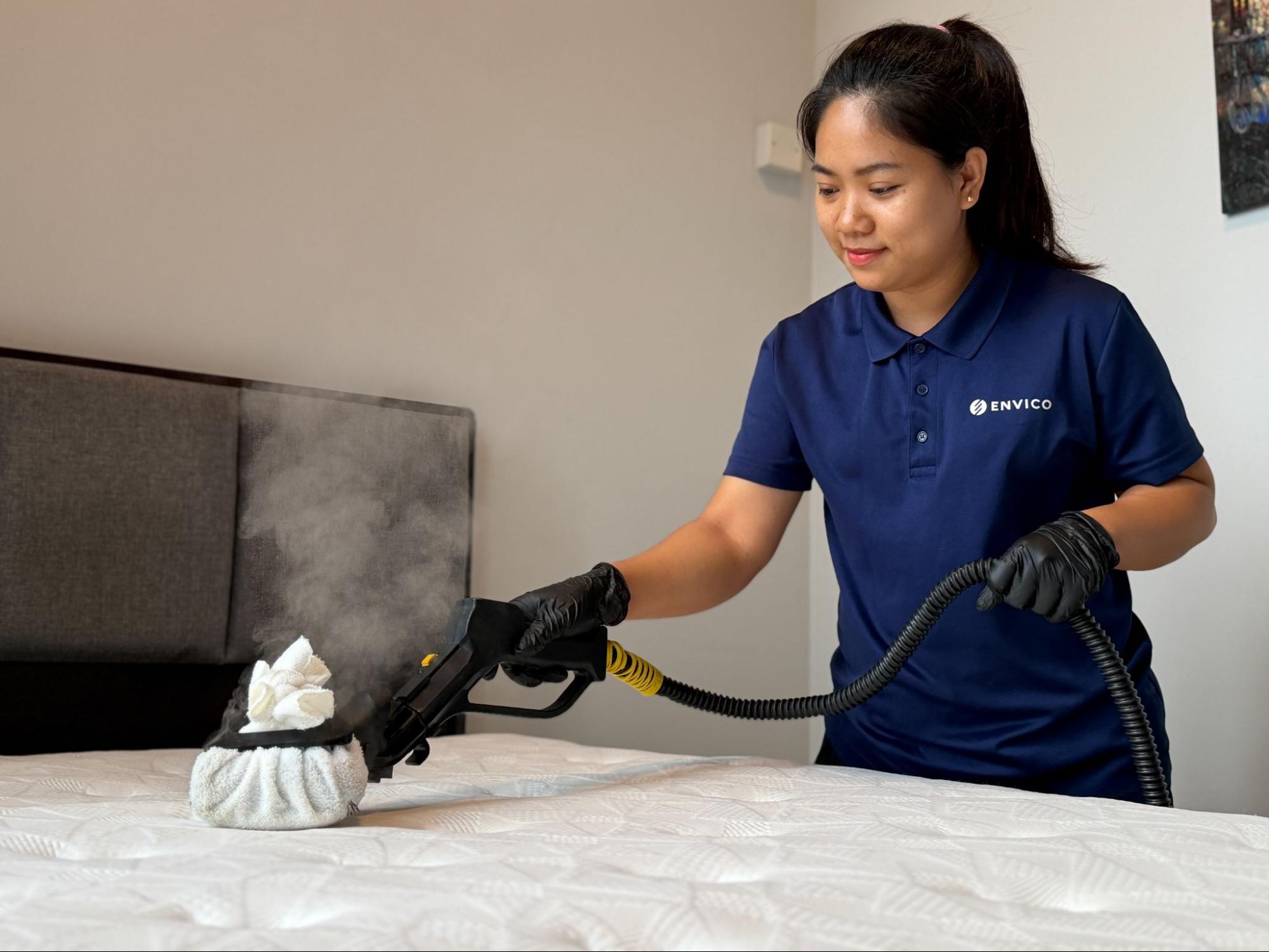
A proper mattress deep cleaning starts with an assessment, not a generic scrub. The material and condition of the mattress determine which treatment method is appropriate; a memory foam mattress and a spring mattress don’t respond the same way to moisture or heat.
From there, the goal is extraction rather than surface treatment: pulling embedded allergens out of the fabric rather than just wiping down what’s visible. Depending on the mattress and the household’s needs, this may involve mattress steam cleaning or another extraction method suited to the material.
Drying time matters too. A mattress needs to be properly dry before it’s safe to sleep on again, and rushing this step undoes much of the benefit of the clean itself.
At Envico, this process uses safer chemical options, which matter for households with children or anyone with sensitive skin, and WSQ-trained crews carry out every clean, matching the treatment to the mattress rather than applying a one-size-fits-all approach.
This is also where a professional clean earns its cost over a DIY attempt with a rented steam machine or a home extraction kit. Commercial equipment is built for stronger, more consistent extraction, and a trained crew knows how much moisture a given mattress can safely take before drying becomes a problem in itself. A mattress that stays overly wettoo long can end up worse off than one left alone, since trapped moisture is exactly what these organisms need to keep thriving.
Mattress Cleaning as Part of a Bigger Indoor Air Quality Picture
A mattress is one allergen reservoir in a home, not the only one. Carpets, upholstered furniture and air conditioning systems all collect similar buildup over time, and they all interact with the same air the household breathes.
Treating the mattress in isolation, while leaving carpets, sofas or air conditioning units unaddressed, leaves real gaps in an allergy management routine. Pairing regular mattress care with broader deep-cleaning services such as upholstery cleaning and floor polishing gives the whole room an uplift, rather than just sprucing up the surface.
For a household that has already invested in a good mattress cleaning routine but is still seeing allergy symptoms, this is often the missing piece. The mattress may be well maintained, while the carpet underfoot, the sofa the family spends evenings on, or the air conditioning unit circulating air through the bedroom overnight still contribute to the same problem. A full deep clean usually closes that gap.
Book a Mattress Cleaning Assessment with Envico
How often a mattress should be cleaned depends on the household, which is exactly why an assessment is the sensible starting point rather than guesswork. Envico provides mattress cleaning services in Singapore built around exactly this kind of household-by-household assessment, using safer chemical options and professional-grade extraction equipment, carried out by WSQ-trained crews.
If it’s been a while since your mattress was properly assessed, book a mattress cleaning assessment with Envico and get a clear answer on what your home actually needs.